

Stress Support
Stressed and foggy?
Your gut is the
missing piece.
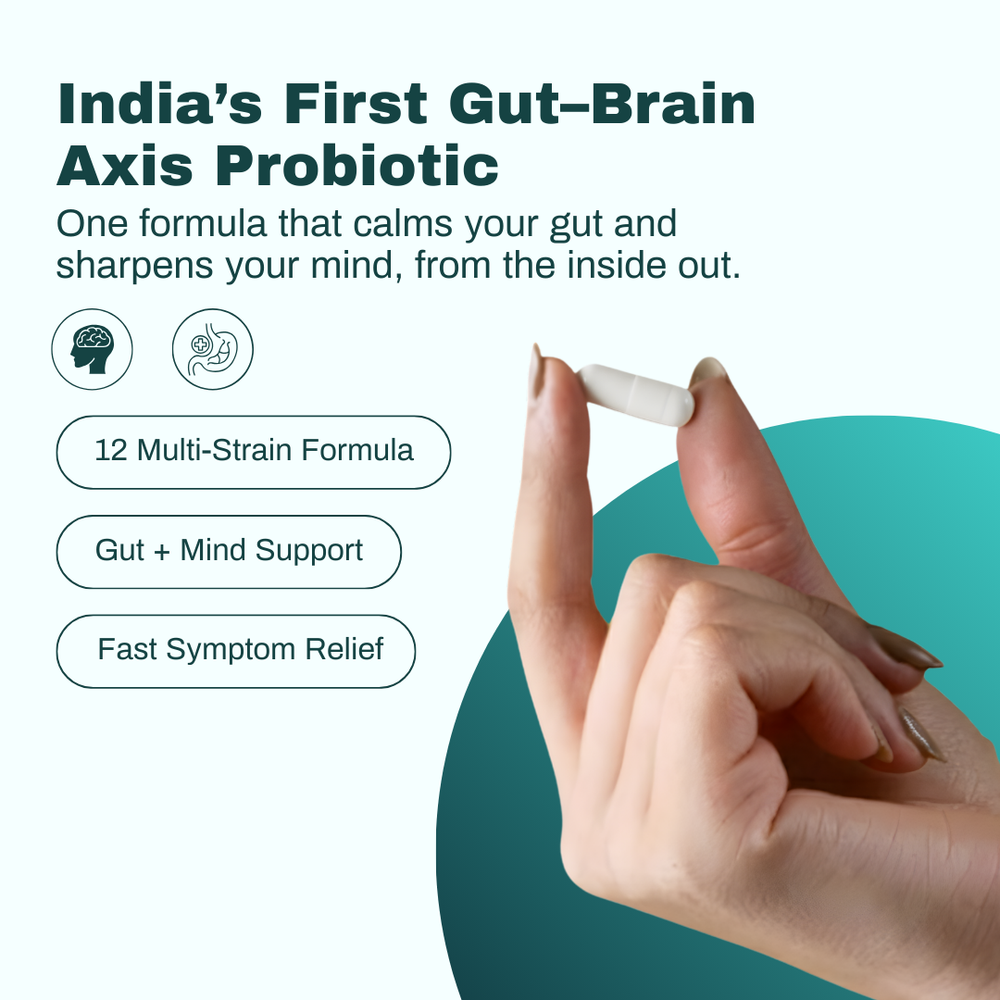
Over 90% of your serotonin is made in the gut, not the brain. When your microbiome is out of balance, the signal to your mind goes quiet. MindFlora is a 12-strain psychobiotic synbiotic engineered to rebuild the gut-brain axis at the source.
- 35 Billion CFU · 12 clinically studied strains — a formulation, not a filler.
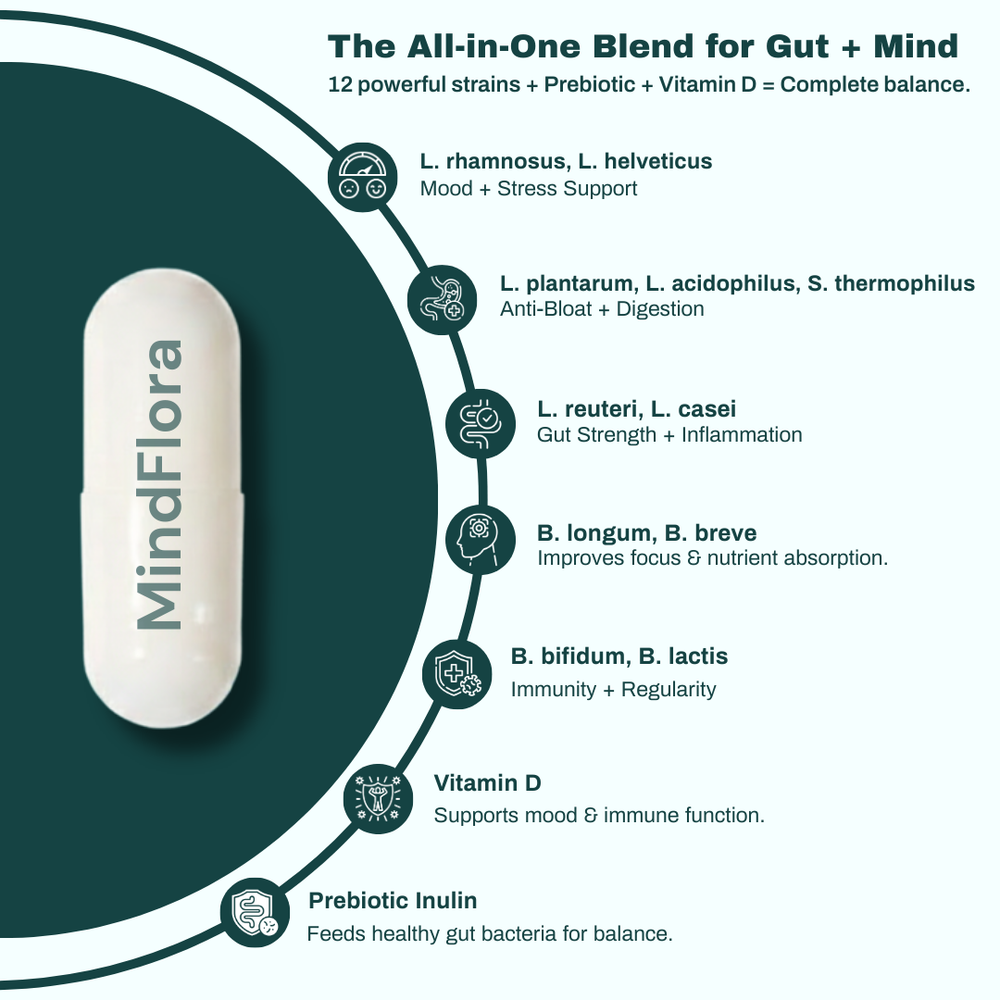
- Synbiotic design — probiotics + inulin (50 mg) + Vitamin D (600 IU).
- Spore-protected delivery via Bacillus coagulans — CFU survive stomach acid.
- Psychobiotic strains studied for cortisol, mood, GABA & serotonin pathways.
Why stress supplements alone never quite work
Ashwagandha, magnesium and breathwork manage the symptom — they blunt a cortisol spike for a few hours. But if the microbiome producing your calming chemicals stays disrupted, the fog keeps returning. You have to rebuild the source.
Typical adaptogens
Work at the symptom level — dampening cortisol temporarily. The gut-brain signalling stays broken, so serotonin and GABA production never recovers. The relief fades; the fog comes back.
Symptom management onlyMindFlora synbiotic
Works at the root — restoring the microbiome so the body can make serotonin, GABA and BDNF precursors naturally. Spore-protected strains actually survive to colonise and do the work.
Root-cause resolutionThe complete equation: balanced microbiome → serotonin, GABA & SCFAs produced naturally → brain fog lifts → HPA stress response normalises → calm, focused and clear, consistently.
One nerve carries most of the conversation
Your gut holds roughly 500 million neurons — more than the spinal cord. It talks to your brain constantly, and about 80% of that traffic runs gut-to-brain along the vagus nerve.
The gut
The microbiome produces or regulates >90% of the body's serotonin, plus GABA, SCFAs and BDNF precursors. When it's balanced, the raw materials for calm are abundant.
The brain
Steady neurotransmitter supply steadies mood, sharpens focus and calms the HPA stress axis. Starve the supply and you get fog, anxiety and restless sleep.
Signs your gut-brain axis is out of sync
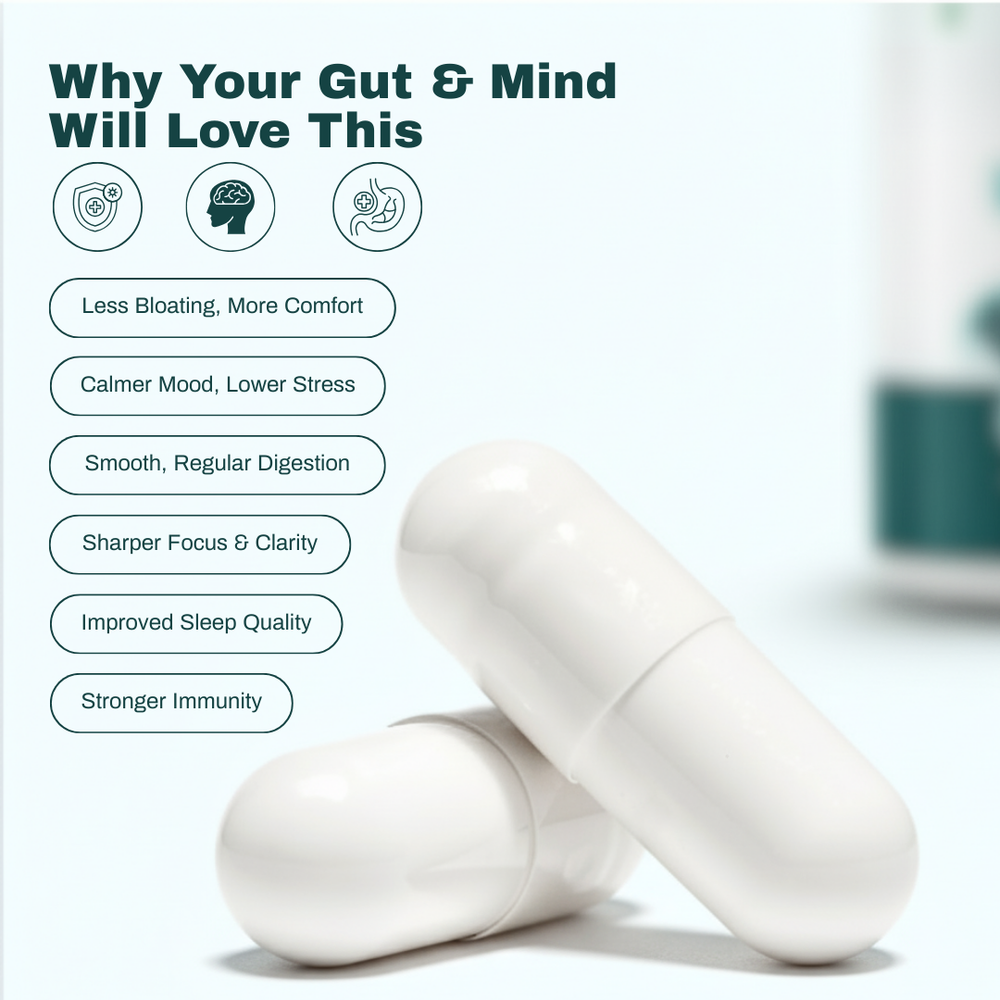
- 01You wake up tired and anxious before the day has even started.
- 02Focus slips — thoughts feel scattered, slow, hard to hold.
- 03Irritable, overwhelmed, or emotionally flat for no clear reason.
- 04Bloating, irregular digestion, or a constant heavy feeling.
- 05Poor sleep quality — even eight hours doesn't feel restorative.
These are signals that the microbiome supporting your brain is struggling. Adaptogens can't rebuild it — only restoring the bacteria can.
Rebuild your gutThe 12-strain formulation, in full
Most probiotics hide behind a single big CFU number. We publish every strain, its role, its dose and the mechanism it was selected for. Open any card to read the science.
01~3.5B
Lactobacillus acidophilus
The cognitive enhancer
Cognitive · GBA
Produces short-chain fatty acids, suppresses NF-κB-driven neuroinflammation and stimulates neurotrophic factors (NGF, BDNF) that support synaptic repair.
- Improved verbal-memory scores in elderly subjects (RCT, Hu et al., 2023).
- Cognitive recovery via microglial peroxisomal pathway (Cell Host & Microbe, 2025).
02~3.5B
Lacticaseibacillus rhamnosus
The HPA-axis regulator
Anxiety · HPA axis
Raises GABA-A receptor expression in anxiety-linked regions, modulates the HPA axis to prevent cortisol hyperactivation and restores tight-junction proteins.
- Systematic review of 15 studies: consistent anxiety reduction via HPA & GABAergic pathways.
- HN001 RCT — improved happiness, lower depression & anxiety (DASS-21), Nutrients 2024.
03~3.0B
Lacticaseibacillus casei
The mood modulator
Mood · Immunity
Stimulates NK-cell activity, raises anti-inflammatory IL-10 while lowering TNF-α and IL-6, and shows superior gastric-acid survival among lactobacilli.
- Improved mood in an elderly cohort — strongest effect at lowest baseline mood (PMC, 2022).
- Lowers depression-linked pro-inflammatory cytokines via NF-κB suppression.
04~3.0B
Lactobacillus helveticus
The cortisol controller
Cortisol · Stress
Reduces urinary free cortisol and dampens stress-induced neuroinflammation in the prefrontal cortex — among the most imaged psychobiotic strains in humans.
- Significant drop in 24-hour urinary free cortisol — direct HPA biomarker evidence.
- fMRI RCT (R0052 combo) altered limbic activity during an emotional task (Frontiers, 2022).
05~3.0B
Lactiplantibacillus plantarum
The neuroprotector
Neuroprotection
Raises BDNF and serotonin in the prefrontal cortex, lowers TNF-α and IL-6, and carries the broadest genome of any Lactobacillus — adapting across gut niches.
- Named most-promising strain for neurodegeneration symptom support (review, 2024).
- With B. longum, additively reduced depression, anxiety & sleep disturbance (PMC, 2025).
06~2.5B
Limosilactobacillus reuteri
The serotonin specialist
Serotonin · Antimicrobial
Stimulates enterochromaffin cells to raise intestinal serotonin and 5-HTP, prompts oxytocin release via the vagus, and produces reuterin, a broad-spectrum antimicrobial.
- Top serotonin-synthesis promoter from in-vitro screening of 5 strains (PubMed, 2021).
- With B. breve, improved mood in 200 postpartum women (RCT, Nutrients 2023).
07~3.5B
Bifidobacterium bifidum
The barrier guardian
Gut barrier · Immunity
Reinforces tight-junction proteins (ZO-1, occludin, claudin), upregulates secretory IgA and produces acetic acid to nourish colonic epithelium.
- Part of a 12-week RCT that improved cognition in Alzheimer's patients (Ma et al., 2023).
- Lowers intestinal permeability linked to endotoxaemia and neuroinflammation.
08~3.0B
Bifidobacterium breve
The epigenetic modulator
Serotonin · Learning
Inhibits the LSD1 epigenetic enzyme that governs neurotransmitter gene expression, promoting GABA and serotonin output on neuronal cells.
- Top-ranking GABA/serotonin promoter in a two-step cell-line screen (PubMed, 2021).
- With L. reuteri, reduced postpartum depression in 200 new mothers (RCT, 2023).
09~3.5B
Bifidobacterium longum
The anchor psychobiotic
Anxiety · Brain activity
The most fMRI-validated psychobiotic strain — modulates limbic and emotional-processing regions, reduces urinary cortisol and feeds GABA/serotonin pathways.
- Two fMRI RCTs altered limbic brain responses under stress tasks (2022).
- With L. plantarum, additively reduced depression, anxiety & insomnia (PMC, 2025).
10~3.0B
Bifidobacterium lactis
The immune optimiser
Immune · Antioxidant
Enhances NK-cell cytotoxicity, stimulates IgA/IgG, and lowers reactive oxygen species via superoxide-dismutase upregulation and reduced CRP.
- With L. reuteri, cut ROS by up to 70% in an ageing model (PMC, 2025).
- Reduces systemic CRP — an independent risk factor for low mood and cognitive decline.
11~2.0B
Streptococcus thermophilus
The microbiome architect
Microbiome ecology
Rapidly acidifies the gut with L(+) lactic acid, synthesises folate (a neurotransmitter co-factor), and creates the conditions Bifidobacterium need to colonise.
- Featured in a widely-cited fMRI study altering emotion-regulation brain activity.
- Produces folate for methylation and dopamine/serotonin synthesis.
12~2.5B
Bacillus coagulans
The spore-forming survivor
IBS · Acid resistance
Forms heat-stable, acid-resistant endospores that survive gastric pH and germinate in the small intestine — producing butyrate and guaranteeing CFU delivery.
- 8-week RCT (BC99): reduced anxiety & depression via the gut-microbiota-brain axis (2025).
- Ambient-stable for >24 months — no refrigeration needed to keep CFU viable.
A fructan fibre fermented into butyrate that feeds all 12 strains — turning a probiotic into a true synbiotic.
Vitamin D receptors sit throughout the brain. Over 70% of urban Indian adults run deficient — this closes the gap.
Spore-protected and acid-resistant, so the stated count is what actually reaches the site of action.
Combinations proven to work as a team
These exact strain pairings have been studied together in peer-reviewed trials — showing additive or synergistic effects, not just co-existence in a capsule.
Five changes, in roughly this order
01
Brain fog lifts
02
Stress steadies
03
Gut calms
04
Sleep deepens
05
Energy returns
Clinically studied strains, cited in full
of serotonin is made in your gut. Restoring gut bacteria directly supports serotonin production — central to mood and clarity (Yano et al., 2015).
healthy subjects, two fMRI RCTs. A helveticus + longum + plantarum blend measurably altered brain activity in emotion-regulation regions (Frontiers in Nutrition, 2022).
to measurable mood change. An 8-week RCT of a spore-forming strain significantly reduced anxiety and depression scores via the gut-brain axis (2025).
of urban Indian adults are Vitamin D deficient. MindFlora's 600 IU dose addresses a co-prevalent gap tied to low mood and cognition.
Full references are listed at the foot of this page.
A big CFU number isn't the whole story
What matters is whether the bacteria survive the journey and whether they're the right strains for the brain. Most products fail one or both.
Standard capsules use no protective coating. Most bacteria are destroyed by stomach acid before reaching the intestine — too few left to shift the gut-brain axis.
Most powders use generic strains chosen for digestion alone — none of the validated psychobiotic strains (like helveticus R0052 or rhamnosus) studied for mood and stress.
Spore-protected, delayed-release delivery carries the bacteria alive past stomach acid. The 12-strain psychobiotic blend targets the gut-brain axis — cortisol down, serotonin up.
How MindFlora compares
Based on publicly available information · for general category comparison only
One capsule a day. Here's the arc.
Take one capsule with water, ideally with or after a meal. Consistency is the active ingredient — most people feel the shift between days 7 and 21.
Take it daily
One capsule with a meal. Simple and repeatable.
Rebalancing
Strains colonise; digestion begins to settle first.
Fog lifts
Clarity and steadier mood start to come online.
Full reset
Sleep, energy and stress response find a new baseline.
Real customers, real clarity
"Years of brain fog — tried nootropics, tried meditation. MindFlora was the first thing that made a real difference. Two weeks in, my thinking is sharper than it's been in years."
"Skeptical a probiotic could touch anxiety — I'm a convert. My IBS calmed down and, more importantly, I feel far less reactive to stress. Subtle but profound."
"Digestion improved first, then around day 10 the mid-afternoon slump vanished. Focusing better, sleeping deeper, generally more even. Incredible."
"As an engineer on 10-hour days, my clarity was wrecked. No evening crash now, better mood, and my gut finally cooperates. Best health investment I've made."
Start your gut-brain reset
35 Billion CFU. 12 psychobiotic strains. Spore-protected delivery. One capsule a day.
FAQ
I already take ashwagandha for stress. Do I still need MindFlora?
How long before I notice results?
What's a "psychobiotic", and how is it different from a normal probiotic?
Why does the acid-resistant, spore-forming delivery matter so much?
What exactly is inside — is it just probiotics?
Is MindFlora safe to take with other supplements or medication?
How many capsules per pack, and how long should I take it?
Scientific references
- Hu et al. (2023). Probiotic supplementation improved the verbal-memory domain in elderly subjects (RCT). Hopkins Verbal Learning Test-Revised. pubmed.ncbi.nlm.nih.gov/41889579
- Zhang et al. (2025). L. acidophilus promotes cognitive recovery via microglial peroxisomal function. Cell Host & Microbe.
- Juvale & Arulsamy (2025). Therapeutic effects of L. rhamnosus on stress-induced anxiety: systematic review of 15 studies (PRISMA). Gut Microbiome. PMC12766537.
- Yang et al. (2024). L. rhamnosus HN001 improved happiness and mental wellbeing: RCT. Nutrients. DOI: 10.3390/nu16172936.
- Rode et al. (2022). L. helveticus + B. longum + L. plantarum alters brain responses (emotional task): fMRI RCT (NCT03615651). Frontiers in Nutrition. DOI: 10.3389/fnut.2022.827182.
- Edebol Carlman et al. (2022). Same mixture alters brain responses during an arithmetic stress task (MIST). PMC9002567.
- Perna et al. (2021). L. reuteri PBS072 + B. breve BB077 on the gut-brain axis: translational screening → human study. PMID 34515196.
- Vicariotto et al. (2023). L. reuteri PBS072 + B. breve BB077 on postpartum mood and depression: RCT (n=200). Nutrients. PMC10458832.
- Park et al. (2025). B. longum P77 + L. plantarum P72 alleviate depression, anxiety and insomnia via GABA/serotonin. PMC12523862.
- Zhang et al. (2025). Weizmannia (Bacillus) coagulans BC99 on anxiety and depression: 8-week RCT (NCT06629441). PMC12525987.
- Meher et al. (2024). B. bifidum + L. acidophilus + B. longum in Alzheimer's cognitive improvement. Food Bioengineering. DOI: 10.1002/fbe2.12081.
- Yano et al. (2015). Indigenous gut bacteria regulate host serotonin biosynthesis. Cell. 161(2):264–276.
MindFlora is manufactured by Fermedicius Labs Pvt Ltd, Bengaluru (WHO-GMP · ISO 9001 · ISO 22000 · ISO 13485) and marketed by SUPRV Innovations Pvt Ltd (FSSAI Lic. 11525998000078). The evidence cited reflects published peer-reviewed literature on the individual strains and their studied combinations; the MindFlora formulation has not itself been evaluated in a standalone clinical trial. This information is provided for education and is not a substitute for professional medical advice. Consult a qualified healthcare provider before starting any supplement, especially if pregnant, nursing, or on medication.
Your brain is waiting for your gut to catch up
You've tried managing stress from the outside. MindFlora's 12 psychobiotic strains rebuild the gut-brain connection so your body produces calm, clarity and focus — naturally.

Someone sent you
10% off!
Error
The referral link is invalid.
Powered by ReferRush