An adjunct nutritional support, not a substitute for medical treatment of postpartum depression. If in crisis, call iCall (9152987821) or Vandrevala Foundation (1860-266-2345).
For new mothers · Postpartum Mental Health Protocol
Postpartum depression starts where mood begins — in the gut.
The nursing-safe psychobiotic containing the exact 2-strain combination proven in an 8-week RCT on 200 postpartum mothers.
🔬
200-Mother RCT-Aligned · exact strain pair from Vicariotto 2023
🤱
Breastfeeding-Safe · non-hormonal, non-drug
🧠
Restores Serotonin + GABA · via the postpartum gut-brain axis
✅
Compatible with SSRIs · safe alongside prescribed care
Crying at 3am for no reasonBaby blues, tears, weepiness that isn't fading past week 3
😤
Rage, snapping, hypervigilancePostpartum anxiety, "mom rage", racing thoughts at night
🌫️
"Mommy brain" that won't liftWord-finding, forgetfulness, feeling disconnected from baby
🤱
Nursing & wary of medicationWant research-backed, breastfeeding-safe adjunct support
1 in 5
Indian mothers face postpartum depression
200
postpartum women in the MindFlora-aligned RCT
~95%
of serotonin is gut-produced
8 wk
to significant mood improvement in the RCT
— The Emerging Postpartum Science —
What if postpartum depression isn't just hormonal — but the direct result of the gut microbiome that got disrupted during childbirth?
For a century, PPD was treated as a hormone-crash problem. Then, over the past 10 years, one of the most significant shifts in perinatal medicine quietly happened: researchers established that childbirth — with its antibiotics, delivery mode, blood loss, sleep deprivation, and stress cascade — profoundly disrupts the gut microbiome. That microbiome, in turn, controls the production of serotonin (95% gut-made), GABA, and BDNF — the exact neurotransmitters underlying mood, calm, and cognitive resilience.
This is now the gut-brain axis of postpartum recovery — an emerging clinical field with published RCTs specifically on new mothers. MindFlora is built on this literature.
Vicariotto et al. Nutrients 2023 · Slykerman Nutrients 2024 · Cryan et al. Nature Reviews Neuroscience 2019
— The Postpartum Gut-Brain Chain —
How 4 disrupted systems after childbirth produce PPD symptoms.
Every postpartum symptom maps to a specific gut-brain mechanism. Each one is documented. Each one is reversible.
The 200-mother RCT — and the exact strain pair inside MindFlora.
In 2023, a randomised double-blind trial in 200 postpartum women was published in Nutrients (PMC10458832), demonstrating that a specific 2-strain psychobiotic combination significantly improved postpartum mood.
L. reuteri PBS072 + B. breve BB077 — the strain pair proven in postpartum women.
In this 200-woman double-blind randomised controlled trial, the exact strain pair inside every MindFlora capsule significantly improved mood, self-confidence, and reduced postpartum depression and anxiety scores over 8 weeks. Mechanism: increased intestinal serotonin (5-HTP) secretion from L. reuteri + GABA + serotonin promotion from B. breve's LSD1 epigenetic modulation.
01
L. reuteri PBS072
Top serotonin promoter (in vitro screen)
02
B. breve BB077
GABA + serotonin epigenetic modulator
📊 Study Outcome
Significant improvements in mood and self-confidence · reduced postpartum depression & anxiety scores · over 8 weeks in 200 new mothers.
Vicariotto F. et al. (2023). Nutrients · PMC10458832
In plain English: MindFlora contains this exact strain pair — plus 10 additional psychobiotic strains, inulin, and Vitamin D. This does not mean MindFlora is a treatment for diagnosed postpartum depression. It means the underlying gut-brain-postpartum mechanism is now clinically documented, and MindFlora is formulated to that documentation. Always inform your treating physician.
— How MindFlora Supports Postpartum Recovery —
Four mood-support mechanisms — medical + plain English.
Every mechanism has a published citation. Every one is explained twice — once for your OB-GYN, once for you.
01
Restores gut-produced serotonin
— why serotonin is your "mood chemical" —
L. reuteri PBS072 stimulates enterochromaffin cells to increase intestinal 5-HTP. Serotonin cannot cross the blood-brain barrier, but its production affects vagal signalling that governs central mood regulation.
In plain English: 95% of your body's serotonin — the "feel good" chemical — is made in your gut. Childbirth disrupts the bacteria that make it. Restoring them restores production.
Perna et al. · PubMed 34515196 · top serotonin promoter
02
Regulates the cortisol axis
— why 3am panic isn't just "in your head" —
L. helveticus R0052 + B. longum R0175 reduce 24-hour urinary free cortisol — the direct biomarker of the stress response. fMRI-confirmed altered limbic brain activity during structured tasks.
In plain English: Broken sleep + newborn stress keep your cortisol stuck high, driving 3am panic, rage, and racing thoughts. These strains help re-regulate that system.
Rode et al. 2022 · NCT03615651 · Frontiers in Nutrition
03
Reduces postpartum anxiety
— what a DASS-21 score is —
L. rhamnosus HN001 significantly reduced DASS-21 postpartum depression and anxiety scores in an independent double-blind trial. Mechanism: HPA modulation + GABA-A receptor upregulation.
In plain English: DASS-21 is a validated clinical questionnaire that measures depression and anxiety. This strain reduced scores in real postpartum women in a controlled trial.
Slykerman R.F. et al. · Nutrients 2024 · DOI 10.3390/nu16172936
04
Corrects the Vitamin D deficit
— why this matters for postpartum mood —
70%+ of urban Indian women are Vitamin D deficient (NFHS 2019–21). Vitamin D regulates BDNF, NGF, and neuroinflammatory cytokines. Low D is independently linked to postpartum mood disorders.
In plain English: Your body needs Vitamin D to make brain-repair chemicals. Most Indian women don't have enough. MindFlora includes the daily dose you need — safe with nursing.
National Family Health Survey 2019–21 · MindFlora §4.2
— Additional Peer-Reviewed Evidence —
The published literature behind every claim on this page.
Postpartum RCT · n=200
Vicariotto 2023 · postpartum mood improvement
The anchor RCT for MindFlora's postpartum positioning. L. reuteri PBS072 + B. breve BB077 in 200 postpartum women, 8 weeks, significantly improved mood + reduced depression + anxiety scores.
Vicariotto F. et al. · Nutrients 2023 · PMC10458832
Postpartum RCT · DASS-21
Slykerman 2024 · L. rhamnosus HN001
Independent postpartum trial: L. rhamnosus HN001 significantly reduced DASS-21 depression + anxiety scores in postpartum women via HPA modulation + GABA receptor upregulation.
Slykerman R.F. et al. · Nutrients 2024 · DOI 10.3390/nu16172936
fMRI RCT · Cortisol
Rode 2022 · limbic brain modulation
Landmark psychobiotic fMRI trial. L. helveticus R0052 + B. longum R0175 reduced urinary cortisol + visibly altered brain activity in emotional-processing regions during structured tasks.
Rode et al. · NCT03615651 · Frontiers in Nutrition 2022
Additive Effect · 2025
B. longum + L. plantarum · additive anti-anxiety
Controlled study confirmed the pair additively alleviates depression, anxiety, and sleep disturbance via joint upregulation of GABA, GABA-A receptor, serotonin, and 5-HT1A in prefrontal cortex.
PMC12523862 · 2025 additive-effect study
— What To Expect —
Your postpartum recovery timeline — week by week.
Not a promise. A mapped arc of what most postpartum mothers on MindFlora report, and the mechanism operating at each stage.
Weeks 1–2 · Foundation
Digestion normalises. Bathroom rhythm returns.
Postpartum constipation, bloating and heaviness ease first. The gut lining begins to seal. Physical repair must precede mood recovery — this is the foundation phase.
MECHANISM · B. coagulans + B. bifidum colonise · SCFA production begins · prebiotic inulin feeds
Weeks 3–4 · The Softening
Sleep gets deeper. 3am panic softens.
First mood shift. The reactivity dials down. Nights feel less spiralling. Cortisol starts normalising. Sleep, when you get it, restores you more.
MECHANISM · L. helveticus R0052 + B. longum R0175 · reduced urinary cortisol
Weeks 6–8 · RCT Window
The 200-mother RCT-documented mood improvements emerge.
This is the 8-week window in which Vicariotto 2023 measured significant mood, self-confidence, and depression-score improvements. You laugh at something silly. You feel like yourself returning.
MECHANISM · L. reuteri PBS072 + B. breve BB077 · serotonin + GABA production peaks
Week 9+ · Sustained
A resilient postpartum microbiome. Steady mood baseline.
The microbiome becomes self-sustaining. Emotional range returns fully — joy, curiosity, patience. This is why 90-day protocol is doctor-recommended for lasting change.
MindFlora vs. the four other things every new mother considers.
Honest comparison. Where each helps, where it falls short, where MindFlora is uniquely positioned.
Waiting It Out
Wait & Hope
Sometimes baby blues resolve on their own. But PPD can persist 6–12+ months untreated. "Waiting" costs the window when postpartum microbiome intervention is most effective.
MindFlora Approach
Research-based nutritional support starting as early as Week 2 postpartum. Addresses the gut-brain-mood mechanism directly rather than hoping symptoms fade.
SSRIs / Anti-Anxiety Medication
Prescription Medication
Necessary for moderate–severe PPD. Prescribed by psychiatrists. Some mothers hesitate while nursing. MindFlora is not a substitute — it's an adjunct alongside medical treatment (with doctor's approval).
MindFlora Approach
Non-drug, non-hormonal, nursing-safe. Complements prescribed medication when advised. No withdrawal, no side-effect profile. Works on the gut mechanism underlying mood.
Curd, Yogurt or Probiotic Drinks
Fermented Foods
Only 1–2 generic strains. Millions of CFU (not billions). No acid-resistance. Zero postpartum-specific psychobiotic strains. Not enough dose to affect the gut-brain axis.
MindFlora Approach
12 clinical psychobiotic strains + Inulin + Vit D · 35 Bn CFU · DRcaps® acid-resistance · exact strains from the 200-mother RCT. A formulation, not a food.
Regular Postnatal Multivitamin
Prenatal / Postnatal Vitamins
B12, iron, Vitamin D. Zero probiotic strains. Doesn't touch the gut microbiome disruption after childbirth — misses the mechanism entirely.
MindFlora Approach
Synbiotic + Vitamin D in one capsule. Restores the postpartum gut ecosystem AND corrects the D deficit affecting 70%+ Indian mothers. Complete postnatal mood-support architecture.
Partner or family of a new mother? Here's how to think about MindFlora.
If you're supporting someone through postpartum recovery, this is one part of a bigger care picture. Not a promise. Not a cure. Here is the honest framing:
Always coordinate with her OB-GYN or psychiatrist — especially if she's on prescription postpartum medication.
Manage expectations gently. Mood changes are gradual — 3-4 weeks minimum. The 8-week RCT window is the honest evidence line.
MindFlora is nursing-safe — no hormones, no drugs. But every mother's situation is unique — confirm with her doctor.
Focus on the physical wins too — better digestion, sleep, and skin are meaningful quality-of-life improvements postpartum.
The 90-day protocol is doctor-recommended for lasting microbiome reset — beyond the RCT's 8-week window.
The Free Doctor Consultation with Pack 90 & 120 is a resource for you AND her — bring your specific questions.
Severe symptoms need medical care. Thoughts of self-harm or harming baby require immediate physician contact — not just supplements.
— Formulated By —
A Johns Hopkins-trained physician — not a marketing team.
Dr. Sumit Siddharth
Nutrition Advisor · Research Faculty · 🎓 Sidney Kimmel, Johns Hopkins University, USA
The postpartum period is a psychobiological event — not just a hormonal one. The microbiome disruption during pregnancy and childbirth is now well-documented, and the strain-specific evidence for restoring it in new mothers is robust enough that gut-brain support should be part of standard postnatal care. MindFlora formalises that protocol — always as an adjunct, always in coordination with the treating physician.
Choose your postpartum recovery protocol.
One capsule daily · 90 days minimum for lasting microbiome reset · nursing-safe · non-hormonal
No. MindFlora is a nutritional synbiotic — not a drug and not a treatment for postpartum depression or any diagnosed condition. It contains the same strain pair (L. reuteri PBS072 + B. breve BB077) proven in a 200-postpartum-mother RCT to improve mood + reduce depression scores. This means the underlying gut-brain-mood mechanism is documented and MindFlora is formulated to that documentation. It is a research-based adjunct nutritional support, never a substitute for medical care.Vicariotto et al. 2023 · Nutrients · PMC10458832
Is it truly safe while I'm breastfeeding?
Yes. Probiotics are considered safe for lactating mothers. In fact, a healthy maternal microbiome benefits your baby via breast milk. MindFlora contains no hormones, no sedatives, no stimulants — only clinical probiotic strains + inulin + Vitamin D at RDA. Please share the label with your OB-GYN if you'd like additional reassurance.
I'm already on an SSRI. Can I take MindFlora alongside?
In most cases, yes. MindFlora is a nutritional supplement — not a psychiatric medication — and does not typically interact with SSRIs, SNRIs, or standard postpartum-prescribed medications. However, every case is different: please confirm with your treating psychiatrist before combining. Many mothers use them complementarily. The Free Doctor Consult (Pack 90+) can help review your specific stack.
When should I start postpartum?
Most mothers begin between Week 2 and Week 6 postpartum. Some start earlier under doctor guidance. Starting by Week 4 means the strains colonise before the peak dysbiosis of Weeks 4–8. If you're several months postpartum and still feeling off, it's not too late — the reset works at any point in the postpartum year.
When will I feel a difference?
Weeks 1–2: digestion + bloat ease · Weeks 3–4: first mood softening, better sleep, less reactivity · Weeks 6–8: the RCT-documented mood improvement window (Vicariotto 2023 measured outcomes here) · Week 9+: sustained baseline. Individual response varies significantly with severity of postpartum symptoms.
How is this different from curd, kefir, or a probiotic drink?
Curd and fermented drinks have very low CFU counts (millions vs. billions), typically 1–2 strains, and zero postpartum-specific psychobiotic strains. They also lack acid-resistance — most bacteria don't survive stomach acid. MindFlora delivers 12 clinical strains at 35 Bn CFU in DRcaps® acid-resistant capsules, plus Inulin (fuel) + Vitamin D. A formulation, not a food.
What if I already have diagnosed PPD?
MindFlora is not a replacement for prescribed PPD treatment or therapy. It is an adjunct — used alongside your medical treatment plan to support the gut-brain mechanism. Many mothers on SSRIs use it complementarily; ask your treating psychiatrist first.
If you are experiencing severe symptoms — thoughts of self-harm, harming your baby, or inability to care for yourself or baby — please contact your doctor immediately or a crisis line: iCall India (9152987821) or Vandrevala Foundation (1860-266-2345, 24/7 free).
What if it doesn't help me?
30-day money-back guarantee, no questions asked. Pack 90 & 120 also include a free doctor consultation worth ₹650 to help troubleshoot dose, timing, or diet factors that might affect your specific postpartum response.
— Begin —
You are not broken. Your postpartum microbiome just needs its ecosystem back.
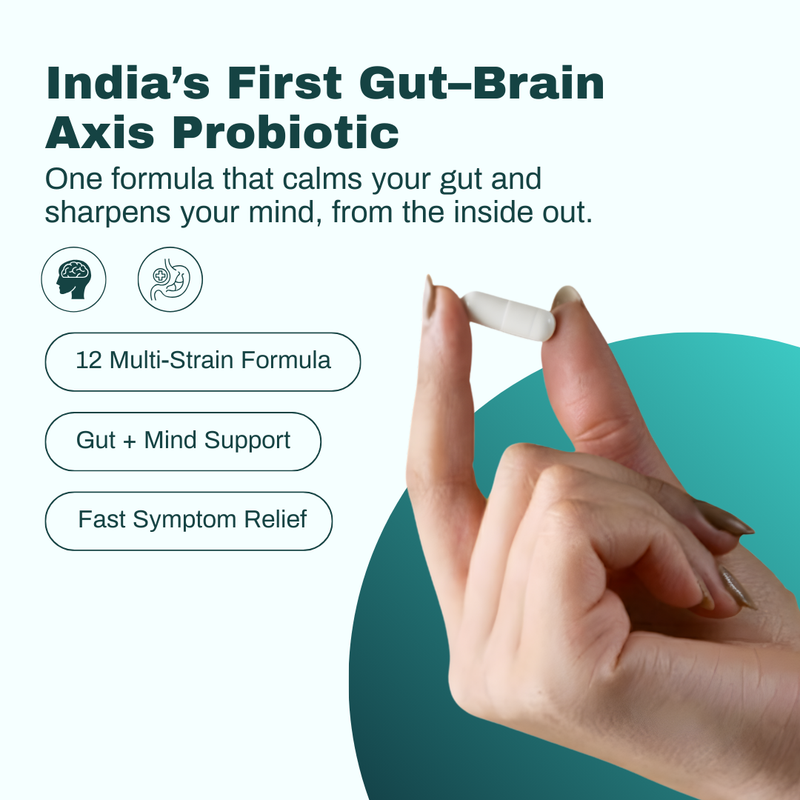
The exact strain pair proven in 200 postpartum women. Plus 10 additional psychobiotic strains, prebiotic inulin, and Vitamin D. In a nursing-safe synbiotic capsule. Research-based. Doctor-formulated. Non-pharmacological.
💛 Nursing-Safe🌿 Non-Hormonal🛡 30-Day Guarantee🩺 Free Doctor Consult · Pack 90+🇮🇳 WHO-GMP · ISO 13485
Medical Disclaimer: MindFlora is a nutritional dietary supplement. It is not intended to diagnose, treat, cure, or prevent postpartum depression or any other disease. The studies cited on this page describe outcomes on the strains contained in MindFlora, but do not establish that MindFlora itself has been trialled as a treatment for PPD. Always consult your OB-GYN or psychiatrist before starting any new supplement, especially while nursing or on prescribed medication. If in crisis — thoughts of self-harm or harming your baby — call iCall (9152987821) or Vandrevala Foundation (1860-266-2345, 24/7 free).